Can You Sell AI-Generated T-Shirt Designs? Copyright, Ownership and What Is Actually Risky
Custom tee $35.85Ready-made from $19.99Printed in 5–7 working daysFree worldwide shippingNo minimum
A blank unisex t-shirt, used to illustrate ownership of a printed design
Short answer: in most countries you can sell a t-shirt with an AI-generated design on it. The harder question is what you own afterwards, and that answer is less comfortable than most people expect.
A necessary caveat before we start: we print custom apparel, we are not lawyers, and none of this is legal advice. Copyright and trademark law varies by country and is moving quickly on this subject. For anything commercially significant, talk to an intellectual property solicitor in your jurisdiction.
Selling is legal. Owning is the complicated part.
There is no law against printing an AI-generated image on a shirt and selling it. What is in question is whether you hold copyright in that image — and therefore whether you can stop anyone else selling the identical design.
The United States Copyright Office has been consistent on this: copyright protects works of human authorship. Output generated purely by a machine in response to a prompt, with no meaningful human creative contribution to the final expression, is not eligible for registration. Prompting alone has not been treated as sufficient authorship, on the reasoning that the prompt influences the result without controlling how it is expressed.
The practical consequence: if your design is purely machine output, you can sell it, but you likely cannot stop a competitor selling the same thing. You have a product, not an asset.
What strengthens a claim
Where a human has made meaningful creative choices in the final work, the human-authored parts can be protectable, even if AI-generated material sits inside it. In practice that means:
- Substantial editing. Redrawing elements, recomposing, combining multiple generations into one deliberate arrangement.
- Original text you wrote. A slogan or caption you authored is your writing, regardless of how the artwork around it was produced.
- Selection and arrangement. Curating and arranging elements into an original composition can attract protection for that arrangement, even when the individual pieces do not.
- Documentation. Keep your working files, drafts and revision history. If you ever need to demonstrate human authorship, contemporaneous evidence is worth far more than a later account of what you did.
Registration applications generally require you to disclose AI-generated content and to identify what a human contributed. Overstating your role on a registration form is a poor idea.
The risk that actually costs people money
Most people worry about protecting their own design. The expensive problem runs the other way: infringing somebody else's rights. An AI model will cheerfully produce a recognisable cartoon character, a football club's crest or a famous person's face, and the fact that a machine drew it is not a defence.
| Design | Risk | Why |
|---|---|---|
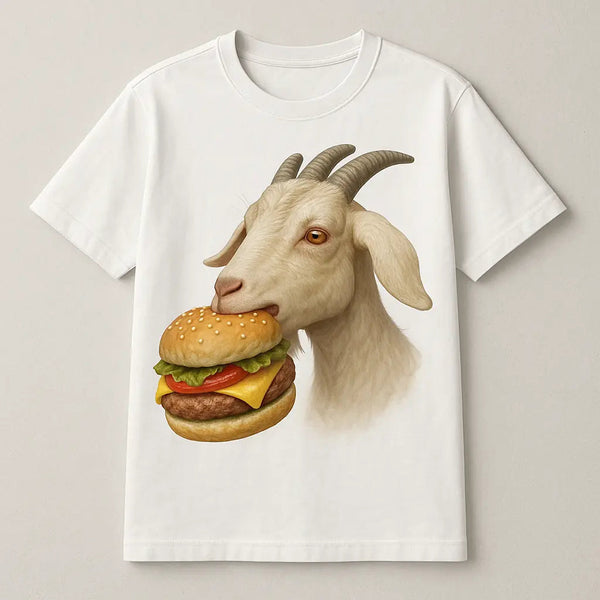
| An original cartoon goat eating a burger | Low | No protected subject matter |
| A character "in the style of" a known studio | Medium | Style is not protected, but the output often lands close to specific protected characters |
| A recognisable cartoon character | High | Copyright, and usually trademark too |
| A brand logo or a recognisable product like a labelled drinks can | High | Trademark and trade dress |
| A living celebrity's likeness | High | Personality and publicity rights, separate from copyright |
| A club badge, league mark or team kit | High | Trademark, aggressively enforced in sport |
| A film or song quote | Medium to high | Short phrases are often registered as trademarks for merchandise |
| A dead celebrity's likeness | Varies | Post-mortem publicity rights differ enormously by state and country |
Two points people consistently get wrong. First, parody is narrower than you think — it generally has to comment on the original work, not merely borrow it for a joke about something else, and commercial merchandise makes that argument harder. Second, "for personal use" is not a shield you can rely on once money changes hands or the item is offered publicly.
What the platforms require
Separately from the law, wherever you sell has its own rules, and they are enforced far faster than any court:
- Amazon Merch on Demand does not ban AI-generated artwork outright, but content, quality and IP policies still apply, and enforcement is automated and unforgiving.
- Etsy requires AI involvement to be disclosed and has tightened its stance on mass-generated listings.
- Redbubble and Society6 both operate proactive IP filtering; repeated takedowns end accounts.
- Most generator tools grant commercial rights in their terms, but that is the tool granting you permission to use its output — it is not a warranty that the output infringes nobody. Read what you actually agreed to.
A takedown is usually a listing removal. A pattern of them is an account closure, and account closures rarely come with an appeal that works.
A practical checklist before you print
- Can you name a specific character, brand, club or person the design depends on? If yes, redesign it.
- Reverse-image search the output. If it is near-identical to an existing artwork, discard it.
- Search the text on a trademark register. Short slogans are registered for apparel far more often than people expect.
- If the design carries commercial weight, make meaningful human changes and keep the working files.
- Read the commercial-use terms of whichever tool produced the image.
How we approach it
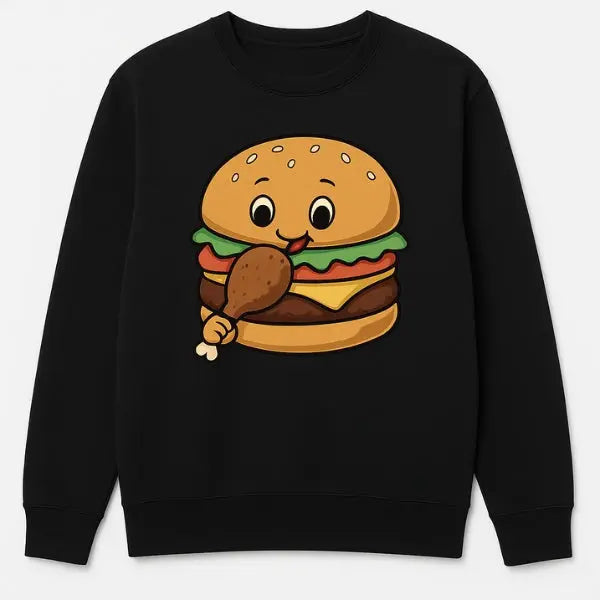
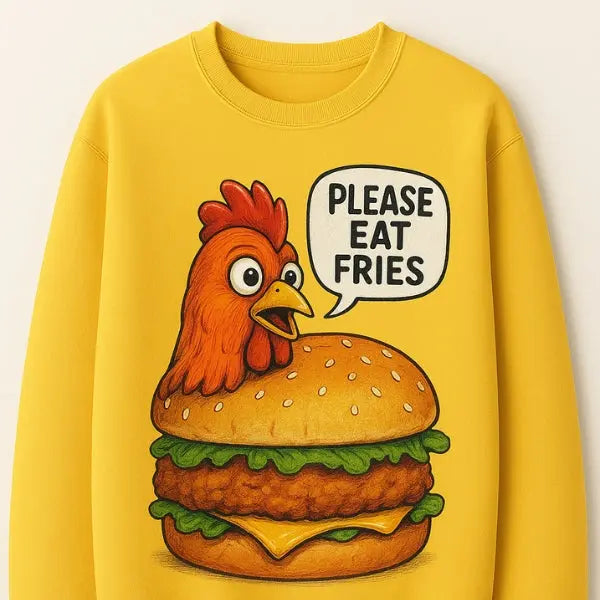
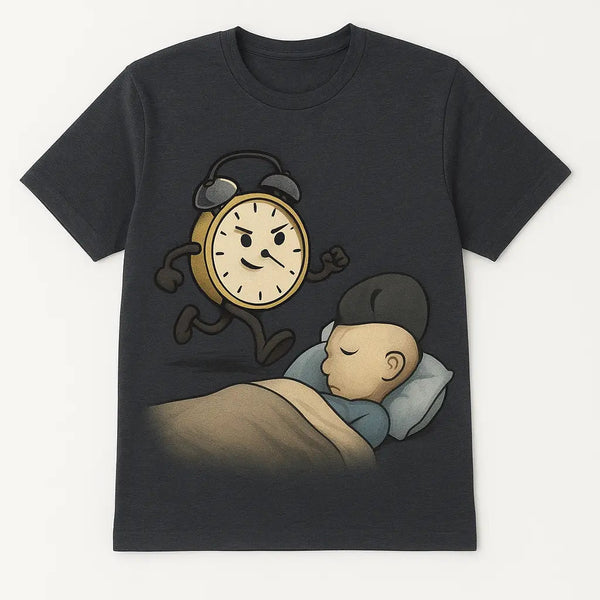
Everything in our funny graphic t-shirts range is generated from an original prompt rather than licensed or traced from existing artwork — goats eating burgers, potatoes fleeing the fryer, alarm clocks sneaking out of bedrooms. That is a deliberate choice, not just an aesthetic one. Original subject matter is the only version of this that scales without a legal department.
If you are designing your own through our AI apparel generator, the same guidance applies to you: describe an idea rather than a property. "A cat in a wedding dress marrying a duck" is yours. "Tom from Tom and Jerry" belongs to somebody with lawyers.
Common questions
Can I copyright an AI-generated design?
Not the purely machine-generated parts, under current US guidance. Human-authored contributions within the work may be protectable, and you must disclose the AI-generated material when registering.
Can someone copy my AI design and sell it?
If there is no protectable human authorship in it, quite possibly yes. This is the strongest practical argument for editing meaningfully rather than printing raw output.
Does "in the style of" a living artist infringe?
Style itself is not protected by copyright. But prompting for a named artist frequently produces output close enough to specific works to cause a problem, and it has become a live area of litigation. It is legally murky and ethically contested — both are reasons to avoid it.
Is one shirt for myself really a problem?
Enforcement against a single private garment is vanishingly rare. That is a statement about the odds of being noticed, not about the underlying legality — and it stops applying the moment you sell or publicly offer it.
If you want to start from something original rather than something borrowed, our 40 funny t-shirt ideas are all written as prompts you can use directly, and every one avoids protected subject matter.