Cotton vs Polyester vs Blends: Which T-Shirt Fabric Is Best?
Custom tee $35.85Ready-made tees from $35.99Printed in 5–7 working daysFree worldwide shippingNo minimum
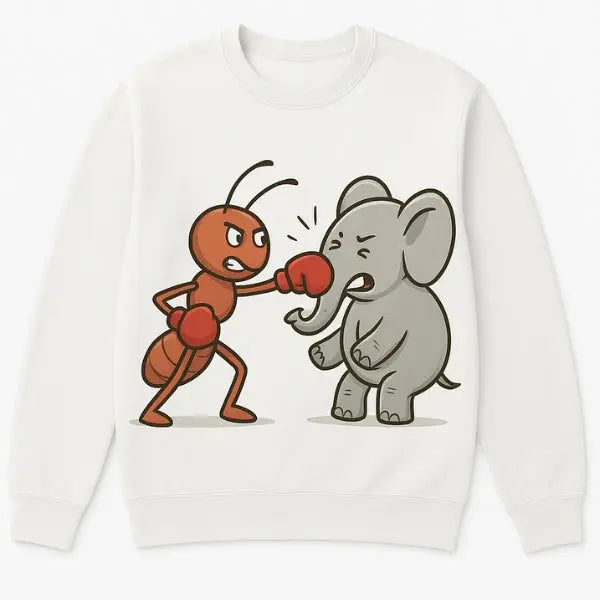
A white cotton sweatshirt with a printed design, used to compare fabric types
Fabric decides how a shirt feels, how long it lasts, whether it shrinks, and how well a design prints on it. Here is the honest comparison.
At a glance
| 100% cotton | 100% polyester | 50/50 blend | Tri-blend | |
|---|---|---|---|---|
| Breathability | Excellent | Poor | Good | Very good |
| Softness | Good | Fair | Good | Excellent |
| Shrinkage | 3–5% | Almost none | 1–2% | Minimal |
| Wrinkles | Yes | Rarely | Some | Some |
| Moisture wicking | No | Excellent | Fair | Fair |
| DTG print quality | Excellent | Poor | Fair | Good |
| Price | Low | Low | Low | Higher |
100% cotton
The default for graphic tees, and the best surface for printing. Water-based DTG ink bonds into cotton fibres, which is why printed cotton feels soft rather than plasticky.
Ring-spun cotton is spun more finely than standard cotton and feels noticeably softer — worth looking for on a product spec. Combed cotton has short fibres removed, making it smoother and stronger again.
Choose it for: everyday wear, printed designs, anything you want to feel natural.
Avoid it for: sport, humid climates, anything where sweat matters.
100% polyester
Synthetic, moisture-wicking, quick-drying, almost shrink-proof and wrinkle-resistant. It is the right fabric for athletic wear and the wrong one for a graphic tee.
The catch for custom apparel: DTG printing does not bond well to polyester. Water-based inks are formulated for natural fibres. Polyester needs sublimation printing instead, which is a different process and only works on light garments.
Choose it for: sports kit, gym wear, high-heat climates.
Avoid it for: printed graphics, anything worn for long periods indoors — it holds odour more than cotton.
50/50 cotton-polyester (CVC)
The compromise, and a sensible one. Softer than pure polyester, less prone to shrinking and wrinkling than pure cotton, cheaper than tri-blend.
Prints acceptably but not as crisply as cotton — colours sit slightly less vivid because only half the fibres accept the ink well.
Choose it for: workwear, uniforms, anything washed constantly.
Tri-blend
Cotton, polyester and rayon. The softest and most expensive option, with a slightly heathered, vintage look and a drapier fit.
Prints come out marginally muted, which suits the aesthetic but is worth knowing if you want bold flat colour.
Choose it for: premium retail tees, anything where feel is the selling point.
What GSM means
Grams per square metre — fabric weight. Rough guide for t-shirts:
- Under 140gsm: lightweight, slightly sheer, summer
- 140–180gsm: standard everyday weight, the majority of printed tees
- 180gsm+: heavyweight, opaque, holds shape, premium feel
Below 140gsm a light-coloured shirt can be see-through, and a print may show faintly on the reverse. It is the clearest single indicator of quality on a spec sheet.
Which should you choose?
- Printed graphic tee: 100% ring-spun cotton
- Sports or gym: 100% polyester
- Staff uniform washed daily: 50/50 blend
- Premium retail feel: tri-blend
- Hot, humid climate: lightweight cotton
Wearlie prints on ring-spun cotton, because DTG and cotton are made for each other. If you need genuine performance sportswear, a specialist sublimation printer is the right supplier.
Frequently asked questions
Is cotton or polyester better for t-shirts?
Cotton for comfort and printing, polyester for sport and durability. For a graphic tee, cotton wins clearly.
Does polyester shrink?
Barely. It is dimensionally stable, which is its main practical advantage over cotton.
What is ring-spun cotton?
Cotton spun into finer, tighter yarn. Softer and stronger than standard cotton at a small price premium.
What GSM is a good t-shirt?
140–180gsm for everyday wear. Above 180gsm is heavyweight and premium; below 140gsm risks being sheer.
Can you print on polyester?
Not well with DTG. Polyester needs sublimation, which only works on light-coloured garments.
See our t-shirt size chart, or browse custom shirts.